
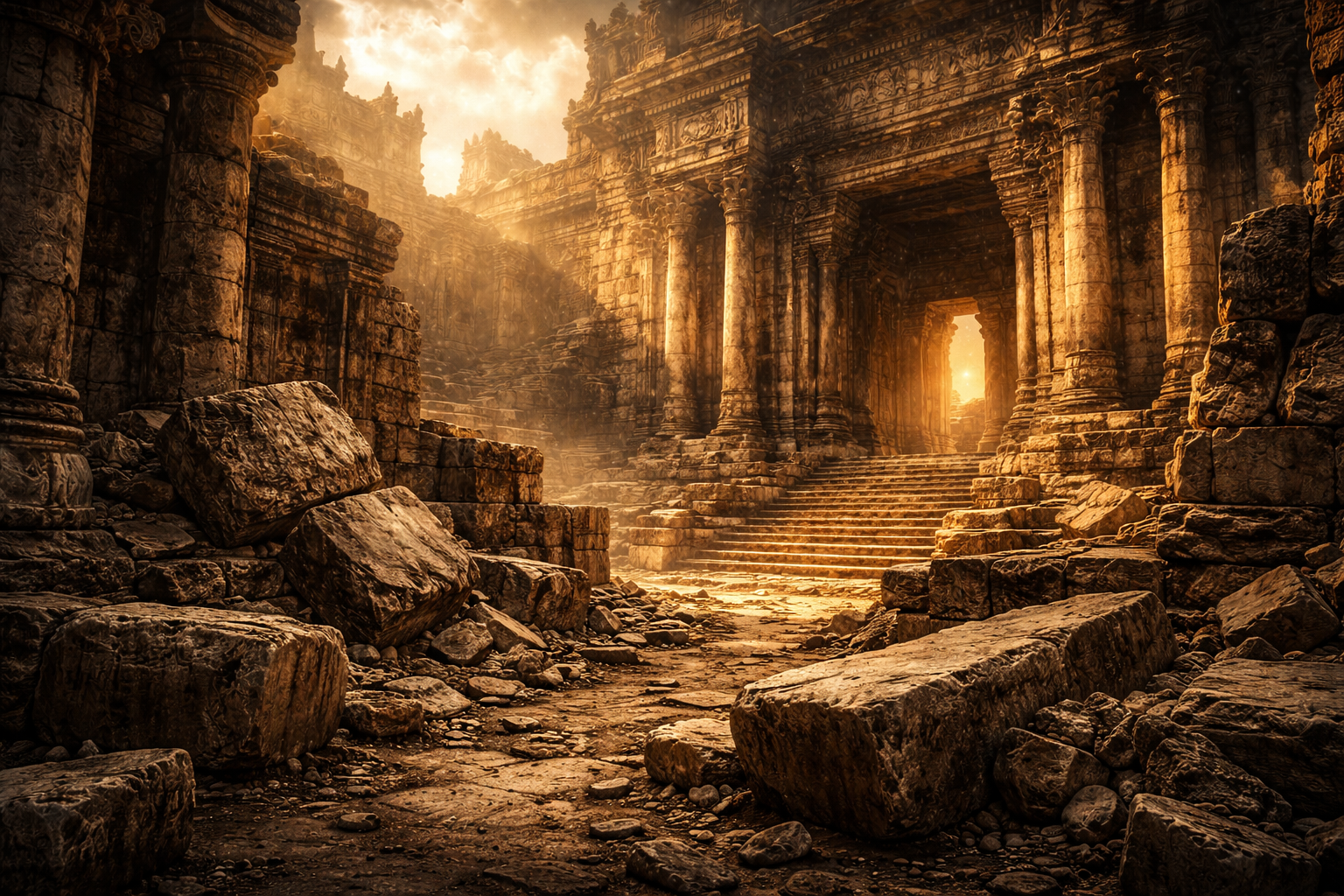
If beliefs shape civilizations, then architecture is where those beliefs become permanent.
Stone remembers what people forget.
Long after documents are revised, narratives reframed, and timelines adjusted, buildings remain—massive, immovable witnesses to the past. They carry assumptions about engineering, labor, technology, and purpose that cannot be explained away by words alone.
And when we examine many of the world’s most impressive structures honestly, something becomes difficult to ignore:
They do not fit comfortably within the story we have been told about history.
The Problem With the Timeline
Modern historical timelines suggest a steady, linear progression:
- Primitive societies
- Gradual technological advancement
- Occasional breakthroughs
- Culminating in modern industrial capability
But architecture tells a different story.
Across Europe, Asia, the Americas, and beyond, we find:
- Massive stone buildings
- Precision masonry
- Uniform design language
- Monumental scale
- Advanced structural understanding
Often appearing suddenly.
Often attributed to populations with no corresponding infrastructure.
Often explained with phrases like “lost techniques” or “we don’t fully understand how this was built.”
Those phrases should raise questions.
Stone That Should Not Exist
Many ancient and “medieval” structures feature stone blocks weighing tens or hundreds of tons—cut, transported, and placed with extreme precision.
Consider what is required:
- Quarrying hard stone with accuracy
- Transporting it over distance
- Lifting it vertically
- Aligning it to tolerances tighter than modern construction often achieves
And yet, we are told this was accomplished with:
- Hand tools
- Rope
- Wooden scaffolding
- And brute force
Sometimes by societies supposedly lacking:
- Steel
- Modern surveying tools
- Industrial logistics
- Or even written technical documentation
At the same time, these same societies are often described as unsanitary, illiterate, and barely surviving.
Both cannot be true.
The Uniformity Problem
One of the most overlooked aspects of old-world architecture is its consistency.
Across continents, we see:
- Similar column orders
- Similar proportions
- Similar domes
- Similar ornamentation
- Similar stone-cutting techniques
This uniformity suggests:
- Shared knowledge
- Shared standards
- Or a shared origin
Yet history insists these structures were built by:
- Isolated cultures
- Over vast spans of time
- With no centralized coordination
That explanation strains credibility.
Civilizations separated by oceans somehow converged on identical architectural principles—without shared tools, texts, or training?
Or… they inherited something.
Buildings Older Than Their Builders
In many cities, the official story goes something like this:
- A population “settled” an area
- They built modest structures
- Then suddenly erected monumental buildings
- Often far exceeding their apparent capability
In some cases:
- The earliest buildings are the most advanced
- Later additions are smaller, cruder, or simplified
- Repairs use inferior materials and methods
This is not how technological progress normally works.
It looks less like innovation—and more like reuse.
The Question of Labor
Modern construction of massive stone structures requires:
- Heavy machinery
- Specialized crews
- Long timelines
- Enormous budgets
Yet we are asked to believe ancient or early-modern societies completed comparable work with:
- Manual labor alone
- Short timelines
- Minimal resources
The labor force required would have been:
- Immense
- Highly skilled
- Logistically supported
Where were they housed?
How were they fed?
Who trained them?
Where is the documentation?
The silence is telling.
Architecture as Infrastructure, Not Decoration
Another assumption worth challenging is the idea that these buildings were merely symbolic or decorative.
Many old-world structures:
- Are overbuilt for their supposed purpose
- Include features that make little sense for ornamentation alone
- Appear designed for longevity, load-bearing, and function
Some researchers suggest these buildings may have served:
- Administrative roles
- Acoustic purposes
- Energy-related functions
- Or roles we no longer recognize
Whether or not one accepts those theories, the core question remains:
Why build at such scale, with such precision, for such limited use?
The Missing Transition
One of the most glaring problems in architectural history is the lack of a clear transition phase.
We are shown:
- Before: simple structures
- After: monumental stone cities
What we are rarely shown is the in-between.
Where are the prototypes?
The failed attempts?
The gradual refinement?
Instead, advanced structures appear fully formed.
That is not evolution.
That is inheritance—or recovery.
Reframing “Restoration” and “Renovation”
Many buildings officially dated to the 18th or 19th century were not constructed from scratch.
They were:
- Restored
- Repaired
- Repurposed
- Or rebranded
In many cases:
- Foundations are far older than the official date
- Lower levels are more massive and refined
- Upper additions are simpler and lighter
This suggests a civilization encountering remnants of something greater—and adapting it.
Not creating it.
Why This Matters
This is not about diminishing human ingenuity.
It is about placing it accurately.
If there was a previous high civilization—or a forgotten global system—then:
- History becomes cyclical, not linear
- Progress becomes recoverable, not guaranteed
- And our place in time shifts dramatically
It also reframes authority.
Those who control history control legitimacy.
The Emotional Resistance
Architecture challenges narratives in a way texts cannot.
You can reinterpret a document.
You can redact a manuscript.
You can reframe a story.
But stone is stubborn.
Standing before a massive structure that “should not exist” creates cognitive dissonance. The easiest response is dismissal.
“That’s just how they did it.”
“We don’t know, but they figured it out.”
“People were smarter back then.”
Those are not explanations.
They are evasions.
A Kingdom Remembered Through Stone
This article does not claim certainty about who built these structures or when.
What it claims is simpler—and more disruptive:
The official timeline does not adequately explain the evidence.
And when timelines fail to explain physical reality, the timeline—not the stone—should be questioned.
What Comes Next
In the next article, we will turn from buildings to something even more sensitive:
History itself.
Not ancient history—but modern history.
Who writes it.
Who edits it.
And why entire centuries can disappear—or be added—without most people ever noticing.
Because once architecture raises the question…
History must answer it.